
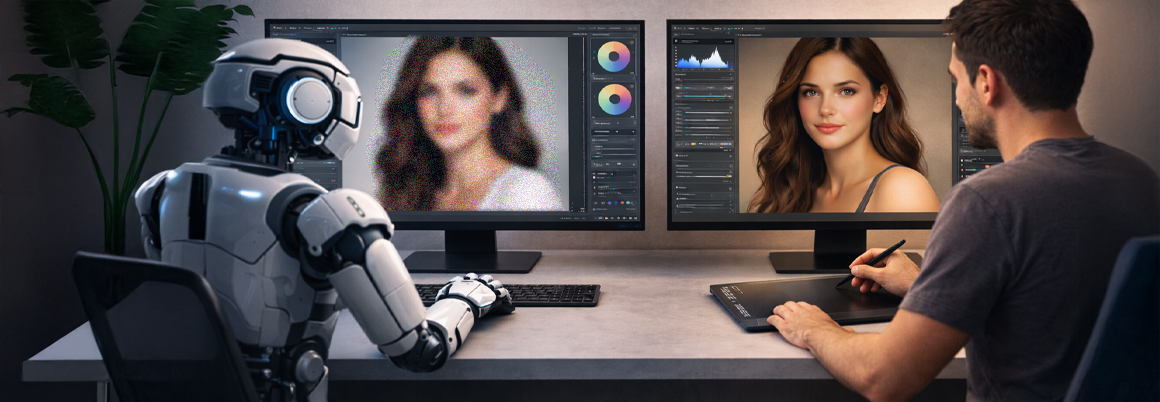
AI photo editing has reshaped how modern businesses handle visual content. What once required skilled editors, layered workflows, and long review cycles can now be executed in seconds using automation. For high-volume brands, the appeal is obvious. Faster output. Lower operational load. Scalable image processing.
And yet, by 2026, many teams are learning a harder lesson. Speed does not equal quality. And automation does not equal judgment.
Despite its efficiency, AI photo editing still falls short in areas that directly impact brand trust, buyer confidence, and commercial performance. That gap is why human photo editors are not fading away. They are becoming more critical.
The AI Photo Editing Boom and the Reality Check No One Expected
Between 2022 and 2025, AI-powered editing tools flooded the market. Background removal, color correction, object cleanup, batch retouching. All promised instant results with minimal effort.
For fast-scaling eCommerce brands, it felt like a breakthrough. Image backlogs disappeared overnight. Product launches moved faster. Costs looked predictable.
But then came the quiet problems.
Marketing teams began to notice inconsistencies across catalogs. Product managers flagged mismatches between images and physical items. Customer support teams dealt with a rising number of complaints that were traced back to visuals.
Not catastrophic failures. Subtle ones. The kind that compounds.
By late 2025, many brands had reintroduced human editors, not to replace AI, but to address what automation had been missing. Context. Intent. Judgment.
That is the 2026 reality.
What AI Photo Editing Actually Does Well
AI photo editing excels when the task is repetitive and the rules are clear. Simple background removal. Basic exposure balancing. Standardized crops for internal use. In these controlled environments, automation delivers real efficiency.
For internal drafts or low-risk assets, AI is beneficial. It removes friction from early-stage workflows.
However, this strength also reveals its limitations.
AI executes instructions. It does not interpret outcomes. It applies logic without understanding the purpose. And once visuals move from internal use to customer-facing channels, that limitation becomes visible.
Where AI Photo Editing Fails When Stakes Are High
When visuals carry business-critical weight, automation alone isn’t enough. The absence of human judgment can turn minor flaws into significant risks.
Context Blindness Is Not a Small Issue
AI photo editing tools do not understand why an image exists. A luxury product campaign and a clearance listing are processed with the same logic. Audience, platform, and intent are not part of the decision-making loop.
Human editors adjust tone, emphasis, and composition according to the context. They know when an image needs restraint. They know when it needs impact.
Automation does not.
Brand Consistency Breaks Quietly Over Time
Maintaining brand consistency in AI photo editing workflows looks easy on paper. Presets. Templates. Style guides.
In practice, drift happens—lighting shifts. Color warmth varies. Shadows behave differently across batches. Studies have also suggested that incorporating AI-generated images into your brand’s visual marketing strategy can have a negative impact on how customers perceive authenticity and value. In addition, when images are unaligned with the existing visual elements of a brand, the likelihood is that a significant number or percentage of images generated by AI at scale will provide inconsistent messaging about the brand’s visual presence.
Human editors actively manage brand consistency in AI photo editing environments by making informed judgments, rather than simply applying parameters.
That difference shows up to customers, even if they cannot explain why.
Product Accuracy Is Where Trust Is Won or Lost
AI frequently struggles with complex textures and materials. Fabrics lose depth. Metallic finishes flatten. Transparent objects confuse edge detection.
These inaccuracies matter. They create expectation gaps that lead to returns and dissatisfaction. They also raise ethical concerns in AI image editing when enhancements cross into misrepresentation.
In regulated or premium categories, this becomes more than a creative issue. It becomes a business risk.
Edge Cases Expose the Limits of Automation
AI systems can produce hallucinated visual outputs where details are fabricated or incorrect, a known failure mode of generative models that impacts reliability in high-stakes imagery. For example, hair against detailed backgrounds, jewelry, glassware, and lifestyle imagery with overlapping elements. These scenarios routinely trigger AI image hallucinations, where visual details are invented, removed, or distorted.
Sometimes the error is obvious. Sometimes it is subtle enough to slip through review.
Either way, it creates risk. And that risk grows with scale.
This is why many brands now treat AI as a preprocessing layer, not a final authority.
The Real Difference Between AI and Human Judgment
AI evaluates probability. Humans evaluate purpose.
An image can be technically correct and still fail commercially. It can meet specifications and still feel wrong. Human editors understand composition, emotional weight, and buyer psychology.
They know when an image needs to evoke a sense of aspiration or groundedness. Or precise.
That gap is not about technology maturity. It is about how decisions are made.
The Hidden Cost of AI Errors in Business Workflows
AI errors rarely explode. They accumulate.
A slightly inaccurate texture here. A color mismatch there. A catalog that feels inconsistent across seasons. In the analysis of controlled perception experiments, observers were able to accurately identify images produced by artificial intelligence roughly 62% of the time. Such a finding suggests that subtle errors may go unnoticed by observers and may pose an obstacle to establishing confidence in the visuals of actual products. The protracted time required to address problems related to visual representation after they are made public can exacerbate the issue.
Quality assurance layers grow. Review cycles slow down. The efficiency gains of automation start to erode.
Ethical research highlights that AI systems must be used responsibly, as they can introduce novel biases and risks of misrepresentation, requiring oversight and transparency when integrated into creative workflows. These are real AI editing risks for brands, particularly when visuals have a direct influence on purchasing decisions.
Human editors reduce these risks upfront by catching problems before they reach customers.
Why Human Photo Editors Still Win in 2026
In a world that is increasingly chasing automation, human judgment remains irreplaceable. When creativity, accountability, and adaptability matter, people consistently outperform presets.
Decisions, Not Presets
Human editors work backward from outcomes. Campaign goals. Platform requirements. Audience expectations.
They edit with intent, not just rules.
Creative Adaptability
Creative work changes fast—feedback shifts. Markets move. Briefs evolve.
Humans adapt instantly. AI systems need retraining or reconfiguration.
Accountability and Ownership
When a human editor signs off on an image, they take on responsibility. Quality, compliance, and brand alignment have an owner.
This matters even more when addressing AI content safety in photo editing, where inappropriate or misleading visuals can damage brand credibility.
The Hybrid Reality Most Brands Are Adopting
The most effective workflows in 2026 are hybrid.
AI handles initial adjustments and volume-heavy preprocessing. Human editors refine, correct, and finalize. This balance delivers efficiency without sacrificing judgment.
It also supports AI-driven brand consistency by ensuring automated outputs align with real-world brand standards through human oversight.
Why Outsourcing Photo Editing Still Makes Business Sense
Despite the rise of automation, many brands continue to outsource photo editing. Not because they lack tools, but because they value predictability.
Professional partners provide trained teams, consistent quality, and scalability without internal overhead. They also support broader strategies, such as Generative Engine Optimization, where accurate and trustworthy visuals enhance performance across AI-driven discovery platforms.
Outsourcing combines the benefits of automation with human accountability. That combination is complex to replicate internally at scale.
How to Decide Between AI and Human Photo Editing
The decision is not ideological. It is practical.
Use AI for low-visibility or internal assets. Use human editing for customer-facing visuals, premium products, and branded campaigns.
Also, factor in governance needs, such as AI image moderation and compliance requirements, when deploying automation at scale.
Risk should determine the workflow, not convenience.
What Photo Editing Looks Like Beyond 2026
AI will keep improving. But its role will remain supportive, not authoritative.
Human editors will increasingly focus on oversight, creative direction, and quality assurance. Photo editing will be recognized not as a mechanical task, but as a brand-critical function tied to trust and conversion.
Final Thought: Efficiency Without Judgment Is Not Quality
AI photo editing delivers speed. Humans deliver meaning.
In 2026, brands that prioritize trust, differentiation, and long-term value do not have to choose between automation and expertise. They combine them.
The future is not AI versus humans. It is automation guided by judgment.
How We Can Help With Professional Photo Editing Outsourcing
If automation has introduced inconsistency, rework, or risk into your visual workflows, professional support can restore control.
Photo Editing Outsourcing offers scalable, human-led photo editing services tailored for brands that prioritize accuracy, consistency, and creative accountability.
Discover how we can meet your photo editing needs. Contact Us Now.
FAQs
2. What are the most significant risks of relying entirely on AI photo editing?
Inconsistent branding, inaccurate product representation, and undetected visual errors can all impact buyer confidence, leading to increased returns and refunds.
3. How do human editors improve brand consistency compared to AI?
Humans apply judgment, not presets. They detect subtle deviations in tone, color, and composition that automation often misses.
4. Are AI-generated visual errors always obvious?
No. Many errors are subtle and only become visible after customers react, making them costly to rectify once they have been published.
5. Is outsourcing still relevant when AI tools are widely available?
Yes. Outsourcing combines the efficiency of automation with the quality control, accountability, and predictable outcomes that humans provide.